
“In the spring of 1988, I returned to New Orleans, and as soon as I smelled the air, I knew I was home.
It was rich, almost sweet, like the scent of jasmine and roses around our old courtyard.
I walked the streets, savoring that long lost perfume.” ― Anne Rice, Interview With The Vampire
The first time I stepped into sultry New Orleans, smelled the brackish air, and saw the camellias, magnolias, palm trees, and sprawling live oaks, I knew I loved it.
My husband and I, newlyweds at the time, moved to New Orleans only a few months later. The years I lived in New Orleans are some of the best of my life. Why? Because New Orleans is a colorful character, full of beauty, and overflowing with surprising charm.

Two weeks ago, my family and I drove to New Orleans, especially to show our oldest son his Cajun roots (he was born there). We toured all of the main parts of the city we thought our boys (15, 13, 11.5) would enjoy. The following is a collection of the photos from the various parts of our 24 hours in New Orleans.
The Colorful Crescent City: a Photojournal
New Orleans sits like a jewel along the Mississippi as it snakes its way through the swamps and marshland on its way to the Gulf of Mexico. The city is known for its excellent cuisine and restaurants, Cajun in influence, abundant with fresh seafood. It’s also notorious for its celebrations: Mardi Gras parties and parades in the weeks leading up to Fat Tuesday and Ash Wednesday, and also for Jazz Fest. In 2005, Hurricane Katrina landed in New Orleans and wreaked her havoc with her own kind of party, destroying much of the city.
The French Quarter
New Orleans started as the Vieux Carré, or French Quarter, built up in the 18th centuries with French and Spanish influences, affected and influenced by the changes around the time of the Louisiana Purchase. Even today, much of the French Quarter, known for Bourbon and Chartres Streets and the never-ending party atmosphere, has the original buildings from the late 18th century. The elevation is 3 ft above sea level, one of the highest in all of New Orleans.

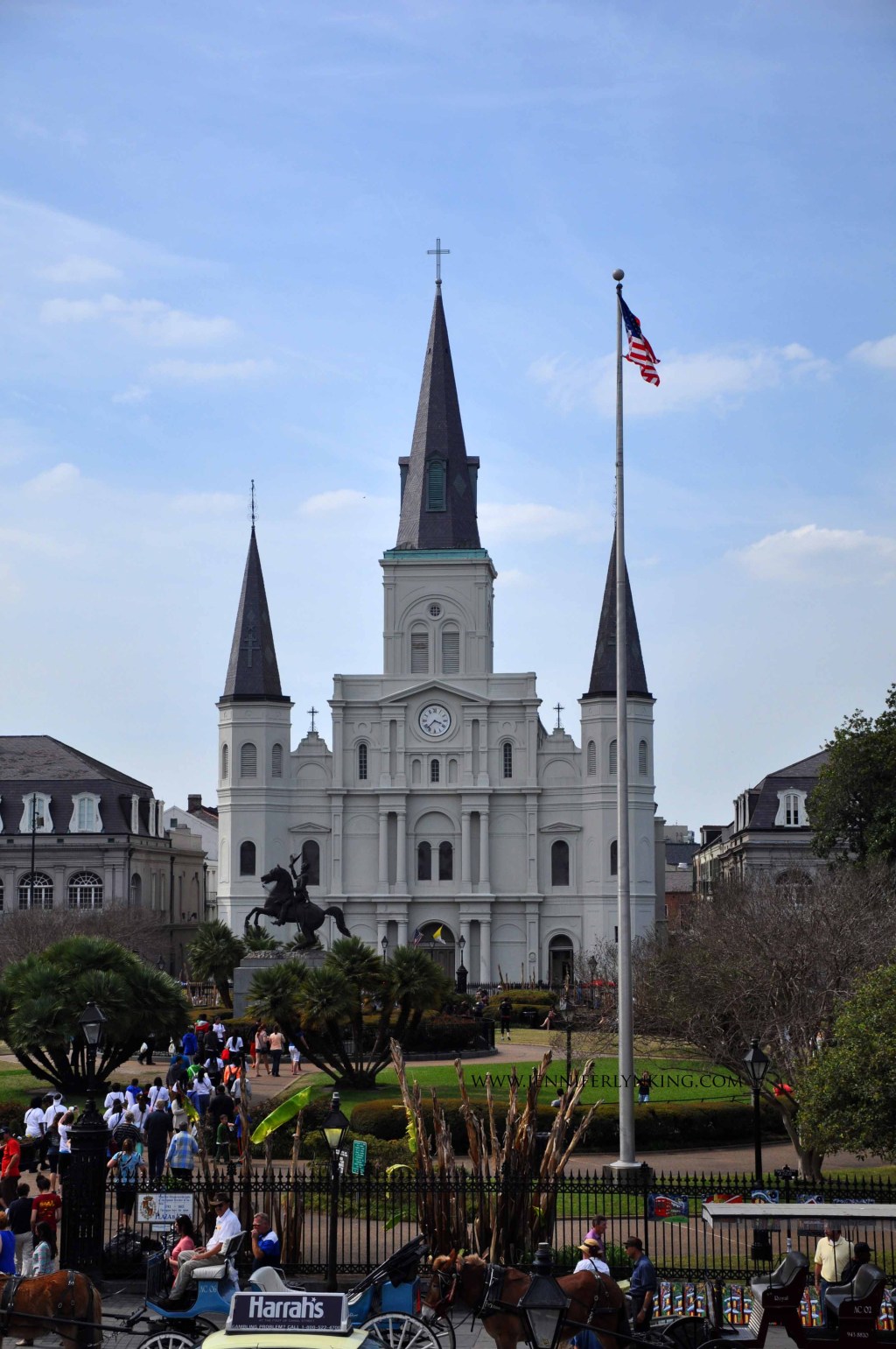
Jackson Square
The area surrounding Saint Louis Cathedral in the French Quarter is called Jackson Square, designed by a Parisian Architect after Place des Vosges in Paris, France. In 1856, a sculpture of Battle of New Orleans hero and US President Andrew Jackson was raised in the center of the square. Today, Jackson Square is colorful, with live brass music, palm readers, and artists lining the walks.


The Mississippi River
Just beyond Jackson Square, across Chartres Street and past the famed Cafe du Monde (with their beignets (New Orleans-style donuts)), if you climb the steps to the top of the levee, you stand on the bank of the grand Mississippi River. Riverboats and more impressive ocean tanker ships navigate the muddy water which passes by the city. The bend in the river at New Orleans forms a giant crescent — why the city is called the crescent city.

St. Charles Streetcar
The St. Charles Avenue Streetcar line is the oldest continually operating street rail line in the world, which began with steam locomotion in 1835. The St. Charles Avenue track leaves the bustle of the downtown business district and Canal Street (adjacent to the French Quarter) and winds through the Garden District and Uptown neighborhoods. It is my favorite thing to do in New Orleans, take a 45 minute one-way ride out of downtown and see the beautiful residential districts.


Audubon Park and Tulane University
Past the Garden District homes, which have a walking tour all to themselves, the St. Charles Streetcar stops at Audubon Park and Tulane and Loyola Universities. These are my other favorite locations in New Orleans, for the grandeur of the university architecture, the live oak and Spanish moss-draped city park with running trail and central ponds, and the quaint streetcar which divides the two.


Lake Pontchartrain
When we lived in New Orleans, we lived just a few minutes outside of the inner city, past the notable cemeteries with their crypts and vaults above ground (caskets float if buried in New Orleans, which is mostly below sea level). Near where we lived, the Causeway leaves dry ground to cross the 26-mile-across lake, Lake Pontchartrain. We had a canal behind our house, which, when it rained (sometimes up to 4″ per hour), the water from the streets drained into the canals, which ran to Lake Pontchartrain, where massive pumps would drive the water from the canals up above the levee walls into the lake. When Katrina struck with its flooding, it breached the levees in Metairie first.

The Swamps
The best part for my husband and I on this trip was getting to watch and hear our sons’ reactions when we crossed the levee on the west side of dry ground in Kenner (near the New Orleans airport). Once you drive on I-10 heading west out of New Orleans, the city changes to murky, moody swampland in an instant.


Other things:
The cuisine, the music, the celebrating — when you travel to New Orleans, you must splurge a little and try some of the best restaurants like Commander’s Palace and eat crawfish in season, listen to some live Jazz, and enjoy a taste of Mardi Gras with beads and even a Hurricane drink. New Orleans is a city like no other in the world, the most colorful in all of the US.
Have you visited New Orleans? What is your favorite part?


Leave a Reply